How to find your 3D printer's hole clearance
A printer prints holes a little small and pegs a little big, by an amount that depends on the machine, the filament and the settings.
Try the round peg, then the square peg, in each hole of the test plate, from the tightest step to the loosest. The step where the peg slides in freely is your sliding clearance. The step before it is your snug fit. Use those numbers in your own designs.
What the test set measures
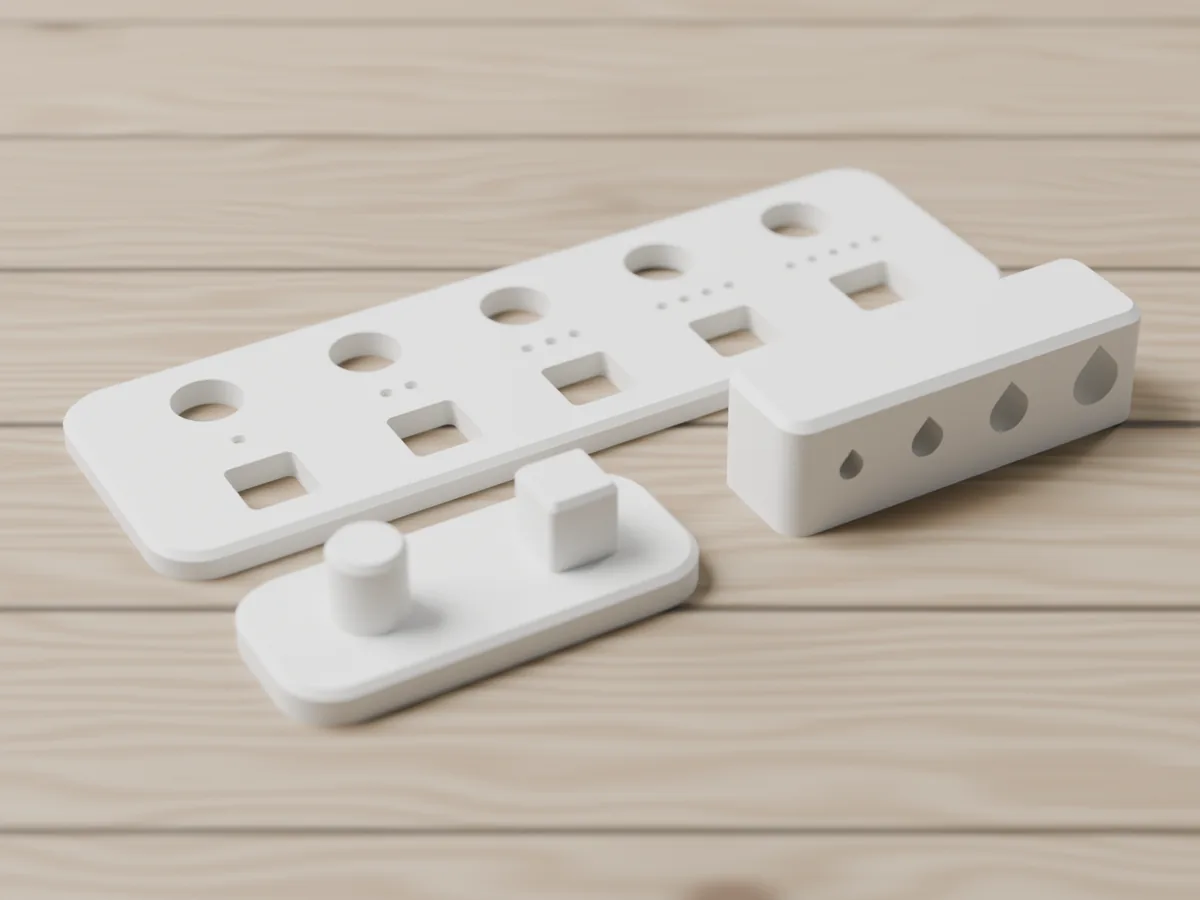
The set is three pieces. The hole plate has five pairs of 8 mm (0.31 in) holes, one round and one square, with total clearance steps of 0.1, 0.2, 0.3, 0.4 and 0.5 mm (0.004 to 0.020 in). Dimples beside each pair count the clearance in tenths of a millimetre. The peg gauge has one 8 mm round peg and one 8 mm square peg. The teardrop block has horizontal holes of 3, 4, 5 and 6 mm with a teardrop top.
Find your fit
- Try the round peg in each hole from the tightest step to the loosest.
- Note the step where the peg goes in with light hand pressure. That is a snug fit.
- Note the first step where it slides in freely. That is your sliding clearance.
- Repeat with the square peg.
- Use those numbers as the clearance in your own designs.
Check horizontal holes
The teardrop block has horizontal holes of 3, 4, 5 and 6 mm with a teardrop top. Print it to check that horizontal holes come out cleanly without supports.
What the numbers mean
The pieces show how a part prints on the printer, filament and slicer that made it. Your own machine will give different numbers, so print your own test pieces before you rely on a clearance. They are for judging by feel, not for measuring to a tolerance.
The tools for this job
- 3D printer accessories · Tools and calibration
Printer tolerance test set
Three test pieces that show how tight your printer prints holes and pegs.
$10.45 CAD$7.95 USD
Every tool ships to Canada and the US. Orders of $50 or more ship free, and you have 30 days to return anything.
Questions
How do I find the right clearance for my 3D printer?
Try the round peg, then the square peg, in each hole from the tightest step to the loosest. The step where it goes in with light hand pressure is a snug fit, and the first step where it slides freely is your sliding clearance.
What clearance steps does the hole plate have?
Five pairs of 8 mm holes, one round and one square, with total clearance steps of 0.1, 0.2, 0.3, 0.4 and 0.5 mm.
Will my numbers match yours?
No. The pieces show how a part prints on the printer, filament and slicer that made it, so print your own test pieces before you rely on a clearance.
Is it a measuring tool?
No. It is for judging by feel, not for measuring to a tolerance.
More guides
- Choose a spool adapter for a filament rack
A spool on a bare dowel slides along it, wobbles and unwinds itself when you pull filament.
Not sure which tool fits your job?
Tell me what you are making and the sizes you own, and I will say which one fits. If you need a jig that does not exist yet, I design those too.
Email me Next guide: Choose a spool adapter for a filament rack